A peaking power station in Queensland, Australia, faced a critical issue with increasing levels of Membrane Patch Colorimetry (MPC) in its lubrication system’s oil.
Varnish formation, caused by the breakdown of oil in turbine systems, can lead to severe consequences, including premature wear of critical machinery, clogged filters, and overheating of components. If left untreated, this can result in costly downtime, operational inefficiencies, and even catastrophic failure of essential equipment.
Recognising the urgency of the situation, the station understood that prompt and effective restoration of the oil to acceptable levels was crucial in minimising these risks and maintaining the operational efficiency of its turbines.
To address this challenge, the station turned to HYDAC Australia, renowned for its expertise in mitigating oil contamination and implementing effective varnish removal solutions.
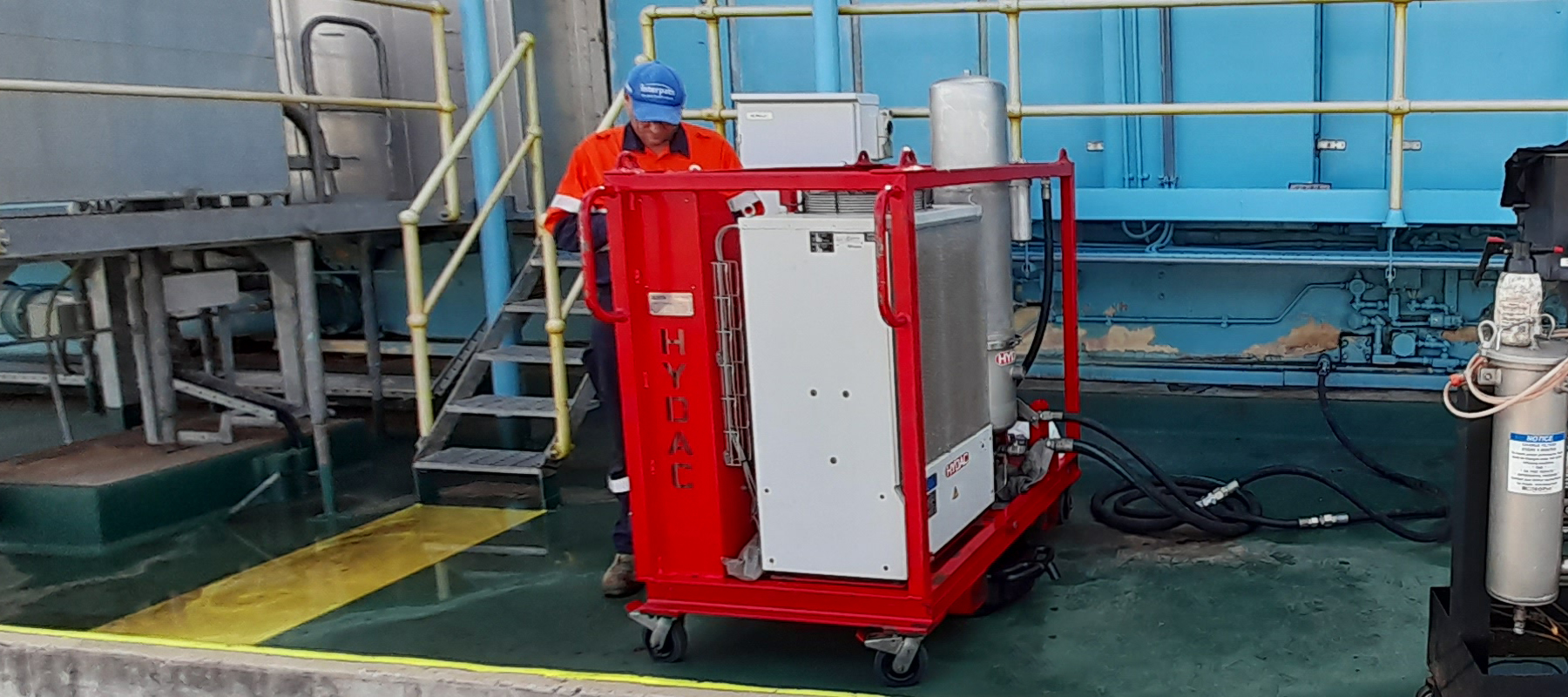
MPC identified potential risks to machinery
MPC, a standard test for detecting varnish formation in lubricant oils, played a crucial role in identifying potential risks to the machinery, according to HYDAC Australia fluid power engineer Albert Dobis.
Mr Dobis says that the MPC test, standardised as ASTM D7843, is a widely used laboratory test for evaluating the likelihood of varnish formation in lubricant oil, which can result in damage and failure of critical machinery components.
The process involves measuring the color of insoluble contaminants extracted from a sample onto a membrane patch.
MPC levels with ΔE <15 are deemed acceptable. MPC levels between ΔE 15-35 are considered elevated and require action. MPC levels exceeding ΔE >35 are deemed critical and necessitate immediate attention. A lower MPC value indicates a reduced risk of varnish formation.
“When MPC values exceed certain thresholds it indicates varnish accumulation that must be addressed to avoid severe damage and failure of essential equipment, which was the case for the power station,” Mr Dobis underscores.
Project objectives for oil contaminant removal
The power station, which operates two natural gas turbines, aimed to eliminate semi-soluble contaminants in the oil that could contribute to varnish formation.
Having experimented with various technologies previously to address the removal of detrimental oil degradation by-products, the station sought to implement a temporary filter system to refine and purify the oil, bringing it to levels of particulate and MPC deemed acceptable.
Challenges in tackling varnish build-up in gas turbine systems
Mr Dobis comments that it is crucial to recognise that the removal of varnish after it has formed addresses only the symptoms, not the underlying cause.
“The operation of gas turbines, in particular, presents a significant challenge for companies when varnish results from the breakdown or degradation of oil within the system. The most common forms of turbine oil degradation include oxidation, thermal degradation, and contamination by foreign substances.
“Thermal degradation is frequently linked to electrostatic discharge in the oil and high-temperature arcing.”
Deposits composed of polymers and acids form a varnish on the turbine's metal surfaces, including filters, valves, piping, and heat exchangers, among others.
The sticky varnish further entraps additional particles within the turbine system, gradually accumulating over time. The build-up of varnish leads to numerous issues, including wear on metal surfaces, clogging of oil flow strainers, filters, and orifices, as well as sticking and disruption of directional valves.
It also causes advanced bearing wear, diminished heat transfer in heat exchangers, and increased friction, heat, and energy consumption due to the varnish's thermal insulation effect, as Mr Dobis explains.
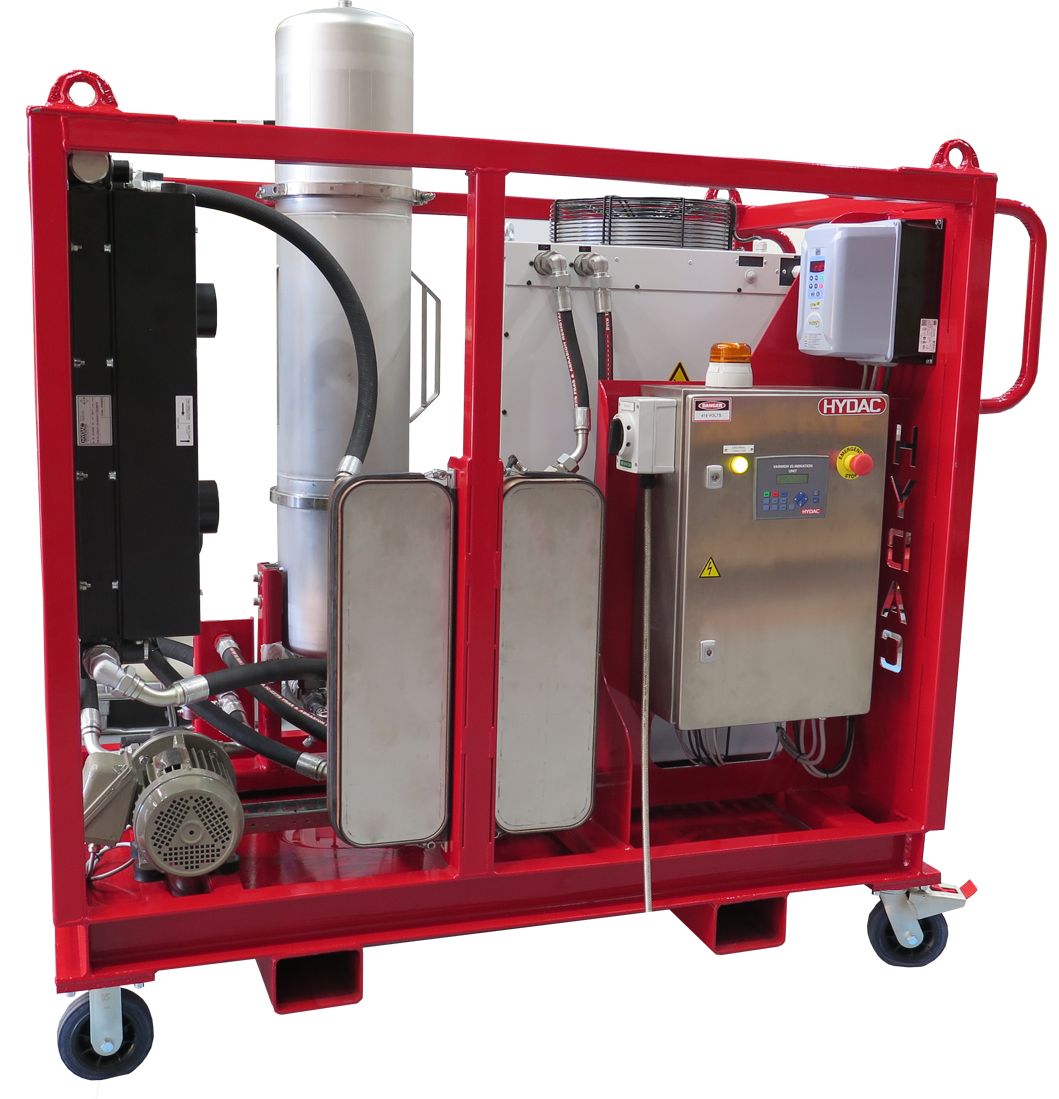
HYDAC solution: varnish elimination with VEU-F-AU
HYDAC proposed the use of the HYDAC Varnish Elimination Unit (VEU-F-AU), an innovative system designed to effectively eliminate soluble and insoluble contaminants through a combination of cooling and high-efficiency filtration, Mr Dobis says.
This system is specifically engineered for the conditioning and restoration of mineral oils that are susceptible to damage from heat and operational conditions, leading to varnish formation and system contamination.
Given the semi-soluble nature of varnish in oil, traditional filtration methods often fall short in completely removing varnish from the oil. Alternative removal processes are typically either slow and costly, or necessitate system shutdown before treatment.
The VEU-F-AU distinguishes itself by offering a fully operational "online and on load" treatment subsystem, enabling varnish removal and oil purification while the system remains in operation.
Moreover, the VEU-F-AU ensures that the processed oil is returned to the tank with only a minimal temperature decrease of approximately 5°C, preserving the existing system's balance and operational efficiency without causing system shock.
Notably, this system does not rely on complex chemicals or mechanisms; instead, it uses reliable OLF-Dimicron filtration elements that are readily accessible both nationally and internationally.
“The VEU-F-AU is versatile and offers a comprehensive solution for the removal of varnish and contaminants from oil,” Mr Dobis says.
“I believe it to be the best, fastest, and easiest-to-use system on the market today.”
In addition, removing varnish from the oil helps extend its lifespan, thereby reducing the need for premature oil changes, which in turn benefits the environment by minimising waste and the demand for new oil. Similarly, the Dimicron filter elements contribute to environmental sustainability by offering safe disposal options, as they are incinerable, further promoting eco-friendly practices in oil maintenance.
Customer benefits: analysis of gas turbine oil before and after VEU-F-AU operation
The comparison of the pre and post-VEU-F-AU operation analysis results for the gas turbine oil is shown below.
Laboratory 1
| Pre VEU-F | Post VEU-F |
Viscosity (cSt) | 33 | 33 |
Water Content (ppm) | 21 | 19 |
Acid Number (mg KOH/g) | 0.16 | 0.16 |
Cleanliness | 22/21/16 | 13/12/9 |
RPVOT (min) | 1442 | 1490 |
MPC | 43 | 1.6 |
RULER Amine (%) | 69 | 67 |
RULER Phenol (%) | <10 | <10 |
“The data show that the VEU-F-AU effectively removed contaminants and significantly decreased MPC values, minimising the risk of varnish formation to nearly zero,” Mr Dobis highlights.
He adds that the VEU-F-AU can achieve these results in a notably shorter timeframe compared to other separation technologies, which often necessitate extended periods and potential machinery shutdowns.
Unlike other technologies, the VEU-F-AU can operate concurrently with machinery operations, further reducing downtime and overall operational costs.
Long-term operational benefits of the VEU-F-AU system
The successful implementation of the VEU-F-AU system at the Queensland power station not only addressed the immediate varnish contamination issue but also provided long-term benefits in terms of operational efficiency.
By effectively removing soluble and insoluble contaminants from the oil, the system significantly reduced the risk of varnish formation, ensuring that the machinery could continue to operate without the threat of costly downtime or failure.
The power station has maintained and continues to maintain its turbines in peak operating condition, all while minimising the need for extensive system shutdowns that typically accompany other varnish removal methods.
Contact us for more information.
You can also watch this video to find out how to use the Varnish Elimination Unit: