The conversion of machine tools to efficient water-cooling systems saves energy at automotive plants. A case study shows just how sizeable returns on investment can be.
The focus on climate protection has highlighted the automotive industry, bringing with it major challenges for stakeholders.
Currently change is inexorably taking place, with pressure to make the supply chain more sustainable, including a slow and deliberate conversion to electromobility.
Of key importance in this regard is reducing the environmental impact of each component and every vehicle produced.
This extends to increased purchase of green energy and reduced energy consumption, waste, CO2 emissions and solvent emissions in the entire value chain, and use of water and other media.
Case study reveals HYDAC’s fluid engineering approach
Energy efficiency, resource conservation and machine tool optimisation.
Germany’s largest automotive manufacturer is one of HYDAC’s customers.
The customer tasked HYDAC with optimising the energy of its machine tools, incorporating this energy into new machines, and reducing energy costs.
Background
The air-conditioning system in the customer’s factory building had not been designed for operating additional machines and hence would not have been able to comply with the building’s maximum permitted temperature in the event of an expansion.
Customer cooling requirements
In view of that, the customer decided on a more environmentally conscious solution in lieu of expanding the air-conditioning unit.
It was decided that the cooling water circuit that was already in place in the factory should be expanded and used for the cooling of the fluid-cooled drives and partial cooling of the switch cabinets.
The customer selected HYDAC as a technology partner and defined the following aims for the cooling task solution:
- Energy saving of at least 20%
- Reduction of a costly cooling technology service
- Amortisation within one to one and a half years
- Waste reduction through reduced coolant consumption
- Reduction in heat transmission to the manufacturing building
- Reduction in noise load
- Requirement for less space in the manufacturing buildings
HYDAC product solutions
HYDAC’s fluid engineering experts performed multiple analyses in the automotive factory.
They recommended conversion of the machines with cooling units to compact fluid-water cooling systems FWKS based on the analyses, with the systems connected to the factory’s cooling water circuit to achieve goals defined by the car manufacturer.
Connecting the machine tools to the external, central cooling water network made it possible to replace the existing cooling units with fluid-water cooling systems from the HYDAC FWKS series.
The FWKS constitutes an intermediate circuit between the cooling water supply and the consumer.
The FWKS tank contains water glycol, which is pumped to the consumer, where it absorbs heat. As it returns to the cooling system, it flows through a plate heat exchanger, where it is re-cooled by the factory’s cooling water.
The intermediate circuit of the FWKS system has two major advantages: first, the quality of the cooling fluid is at a consistently high level and corrosion protection is always provided.
Furthermore, the required pressure and flow rate are ensured, even if the pressure of the factory’s cooling water supply fluctuates or is generally too low.
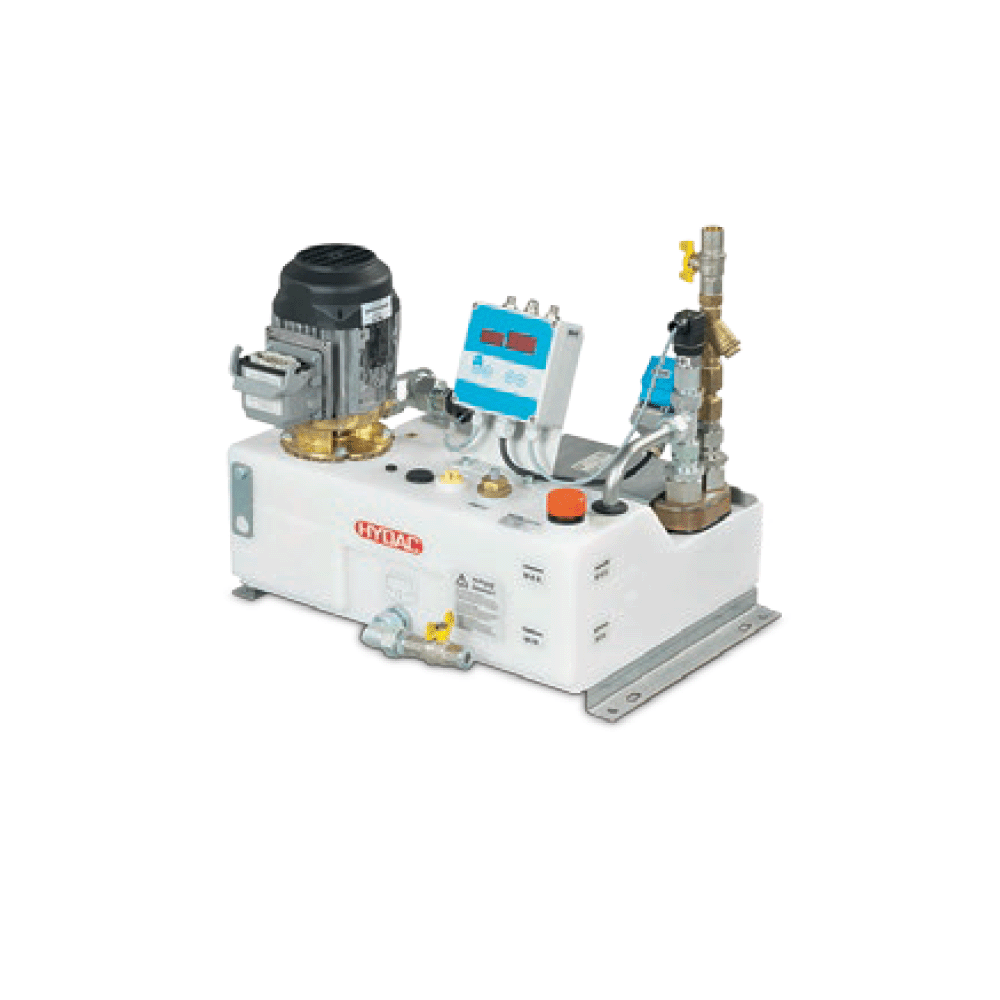
Use of sizes FWKS-2 and FWKS-3
At the factory, machines requiring a cooling power of up to 5kW were converted to the FWKS-0 solution, and for cooling powers above 5kW, sizes FWKS-2 and FWKS-3 were used.
HYDAC FWKS are already much more energy-saving than the cooling units that are generally used in machine tools.
Fitted water control valves
To further reduce the cooling water consumption, the systems can be fitted with water control valves that are controlled either mechanically or electronically.
- Mechanically controlled proportional valves do not require an additional electrical connection. They can adjust the cooling water volume to allow the water glycol upstream from the consumer to remain at a fixed value, with a deviation of ± 2K. This means that for a supply temperature set to 30°C, the water glycol temperature can fluctuate within a range of 28–32 °C.
- Electronically adjusted proportional valves enable differential temperature control with a variation of ± 0.5K.
- The water glycol temperature is based on the machine’s bed temperature. This rises and falls in accordance with the performance of the consumer and ambient temperature and fluctuates in a range of 0.5K in relation to the reference temperature. Temperature fluctuations that could impact the accuracy of the machine are therefore prevented in all cases.
The outcome
Eight machine tools were successfully converted in a test run at the customer’s premises.
Four FWKS variants were set up and used as custom series devices. Following a successful test run, 140 more machines were converted, and in the next step more than 80 machines followed.
To ensure that the new cooling standard is also specified for new machines, the HYDAC FWKS solution has been set down in the customer’s corporate product requirement specification.
Supplier machine manufacturers now use HYDAC fluid cooling systems in their machines.
Cooling system conversion benefits
Resource conservation:
No CFCs or coolants are needed. The proportional valve technology also ensures that cooling water is only used as needed. This means that unnecessary impact on the cooling water network is avoided.
Cost optimisation:
Lower costs for purchasing and service compared with the cooling units that were originally used.
The costs for external commissioned services for cooling technology have been significantly reduced. The factory’s internal mechanical maintenance team can perform the maintenance as no special cooling technology training is required.
Rapid amortisation:
Cost optimisation shortens the amortisation time of the investment.
Flexible system solutions:
Modular and customised solution expansions are possible at any later date.